

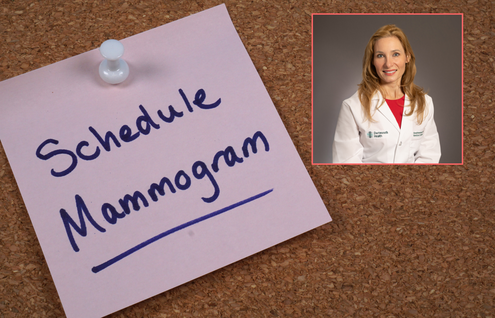
Marie Elaine, MD, joined the radiology team at Southwestern Vermont Medical Center (SVMC) in September 2026, bringing her expertise and subspecialty interest in breast imaging, women's imaging, and public health.
In recognition of Breast Cancer Awareness Month, we asked Dr. Elaine about her background, breast health, and importance of regular screening.
Q: Dr. Elaine, why did you choose breast imaging as a specialty?
Dr. Elaine: I enjoy being part of a multidisciplinary team that supports breast cancer patients from the time of diagnosis through surgery and beyond treatment. it's important to me that patients know their full clinical team— including the radiologist reading their mammogram— has their backs throughout their journey.
We want to diagnose breast cancers early, when they are easier to treat, so that our patients can have the best possible outcomes.
Q: Why are mammograms considered the most effective screening tool for cancer?
Dr. Elaine: One in eight women will be diagnosed with breast cancer during their lifetime. Screening mammography is the only screening test scientifically proven to reduce a woman’s risk of dying from breast cancer.
For women at average risk, beginning annual screening mammograms at age 40 provides the greatest benefit from this life-saving test.
Q: Can you explain breast density and how this may impact my screening?
Dr. Elaine: Breasts are made up of glandular breast tissue and breast fat. Younger women have more glandular tissue. As we get older, the glandular tissue tends to decrease. Hormones, age, and genetics all play a role in breast density.
You cannot determine breast density through a physical exam. The only way for a patient to know her breast density is through a mammogram.
On a mammogram, breast tissue looks white and breast fat appears gray. Breast cancers also look white on a mammogram. For this reason, the sensitivity of screening mammography decreases in women with dense tissue because "white" breast cancers are harder to detect amidst dense "white" breast tissue.
Some women with dense tissue choose to add screening breast ultrasound to their yearly mammogram, which picks up additional cancers not seen on the mammogram.
Q: What is one thing you wish everyone knew about breast cancer screening?
Dr. Elaine: Mammography can be scary, but it is a life-saving test. If you’ve delayed your mammogram for any reason, it’s important to come in and get checked.
The good news is that most mammograms are normal. Some patients will need to return for additional testing, but most of those cases also turn out to be benign.
If there is anything concerning on a mammogram, we want to find it as early as possible. The goal of screening mammography is to diagnose breast cancer before you can feel a lump.
Q: Where should someone start when it comes to understanding their breast cancer risk or scheduling a mammogram?
Dr. Elaine: In addition to speaking with your primary care provider (PCP) or OB/GYN provider, the Susan G. Komen Foundation provides helpful educational resources on breast cancer risk and screening guidelines. To be scheduled, patients need referral for a screening mammogram from either a PCP or OB/GYN office.
Eligible Vermont residents can benefit from the You First program, covering the cost of breast cancer screenings and diagnostic follow-up.
More on Dr. Marie Elaine:
Dr. Marie Elaine is a general radiologist with sub-specialty interest in breast imaging, women's imaging, and public health. She completed a diagnostic radiology residency at Boston University Medical Center, an internal medicine internship at Mount Auburn Hospital, and a breast imaging and intervention fellowship at George Washington University. Dr. Elaine has also pursued an MPH from The George Washington University Milken Institute of Public Health. She has been practicing for over 11 years in both community and academic radiology roles, including as Director of Breast Imaging at Roswell Park Comprehensive Cancer Center in Buffalo, NY. She joined the radiology team at Southwestern Vermont Medical Center in September 2026.
More breast health information from SVMC's experts:
Breast Cancer: Do you know the signs?